Wednesday, August 18, 2010

A trip into the Karakorum mountains of Pakistan - Broad peak (8047m)

After just spending 2 months in the mountains of Pakistan and adjusting back into life at home, the memories of my time travelling, trekking and climbing come flooding back. The overriding emotion from this trip is a feeling of helplessness. This is an account of the trip from my perspective which will obviously differ from others. Watching the news on TV and seeing the devastation and human misery caused by the massive flooding in Pakistan brings a new perspective to the challenges we chose to face in the mountains of Pakistan.

More than 140 million people are currently affected by the disaster and more than 2 million are without homes or shelter. Some villages were wiped out completely and don't even make the news or total count as they are too remote. It is hard to even imagine how bad it is amid the devastation. It feels helpless to be at home and not being able to help.

Sure, we venture to the mountains to try to climb to the summit of a mountain, but the experience and the journey becomes more complex than simply getting to the top of something. Let's face it, everything has to be in your favour to succeed on the mountain- the weather, winds, snow conditions, health, acclimatisation and a good team. The word "Insh'allah" which is so commonly used in Pakistan is perhaps the best description of the entire trip and the attitudes of the country and its people.

"Insh'allah"literally means 'God Willing' and reminds me of the Indian head waggle that becomes a response to most questions that are asked. Will the weather be good? Will the planes fly? Any idea where my luggage is ? Are the roads open or blocked by landslides? It is easier to leave it to Allah than check on the internet for a weather forecast so the response is usually "Insh'allah". In truth, it does actually become rather amusing after a while when you realise that there is no ill intentions involved. It is just a completely genuine belief and trust in Allah.

After 4 days waiting in Islamabad for a flight to Skardu in the mountains of North Eastern Pakistan, Chris and I decided to travel by road on the infamous Karakorum Highway (KKH). I had just spent the previous 2 days in bed with the chills and fevers associated with some 3rd world gastrointestinal bug so the upcoming 28-hour bus ride wasn't particularly inviting.

We drove through the night along the incredible KKH. The road which follows the massive Indus river is an incredible feat of engineering continually threatened by landslides and crowded with the intricately decorated overloaded trucks carrying goods to and from China and through Pakistan. Around 5am in the morning, as we were driving through a town called Besham (near the head of the Swat Valley), we passed a few jeep loads of armed militia. with bandoliers of bullets and kalashnikovs and turbans, we just covertly closed the curtains and kept our heads down. :-))

After a night in Skardu in the heart of Baltistan in north eastern Pakistan, we packed into some vintage jeeps for the 6 hour journey to the mountain village of Askole, the end of the road before we set out on foot toward the Baltoro glacier and 8000m giants of the Karakorum. At Askole, we sorted and distributed the 25 kg loads of food and equipment to the eagerly awaiting porters to carry to base camp.

After 2 days of walking we arrived at a small oasis of trees known as Paiju (3480m), the last camp before stepping onto the Baltoro glacier where we would be spending the next 6 weeks living on the ice, rock and snow.

Paiju is a traditional rest day for porters carrying loads up the Baltoro for climbing and trekking expeditions and a party ensued with the porters and Pakistani staff singing and dancing into the night. We just enjoyed a fantastic meal of BBQ yak.


The following few days of trekking led us toward the campsites of Urdokas (4130m), Goro II(4500m), Concordia(4720m) and finally Broad Peak base camp. Somewhere on the 8 hour walk to Urdokas, an excruciating pain developed in my knee. With pain killers, the walking became bearable but any injury in this environment causes concern. I hope it was just a case of trekkers knee that would go away after a bit of rest. The knee continued to plague me intermittently for the rest of the trip but I somehow managed to keep it under control and still climb. With all the training, preparation and cash forked out for a trip, its always disappointing and frustrating to get injured in an apparently benign situation.

The trip up the Baltoro has to be one of the most awe-inspiring treks in the world. Massive jagged and steep peaks surround the trekker on all sides. The incredible Gasherbrum IV (7995m) dominates the view as one approaches Concordia, where K2 (8611m) and Broad Peak (8047) come into view. The area has been labelled the Throne room of the mountain gods which is probably a perfect description. 4 of the worlds 14 8000m peaks lie in the area.

On arriving at base camp (4900m), we proceeded to build our tent platforms on the moraine of the glacier. 6 weeks later, our tents would be sitting on platforms elevated a few feet above the surrounding moraine because of the glacial melting of the ice around our tents. The glaciers are in a constant state of flux, always melting and gradually moving their way downwards. The glaciers are massive rivers of ice , sometimes 100s of metres thick. There was not a blade of grass, flower or tree to be seen anywhere. This was to be home for the next 6 weeks.

After a few days of rest and acclimatisation at BC, we began work on the mountain. The height of Broad Peak demanded that we set up a few camps on the mountain and gradually acclimatise to the altitude. We carried ropes, fuel, tents and personal equipment up the mountain, trying to climb high and sleep low to maximise acclimatisation, maximise recovery and minimise the chances of severe altitude sickness.

Our team consisted of 14 climbers, 2 trekkers who had accompanied us to BC, 3 high altitude porters (HAPs) and our Pakistani cook staff. We were a diverse group from all parts of the globe. There was a broad range of experience between us. Fabrizio, the leader of the trip came with a wealth of high altitude experience and exceptional fitness and strength. The pressure he was under running the dual expedition to K2/Broad peak was unenviable. Chris was the co guide for Broad Peak and Ben, a fellow Australian and myself were assistant guides. I had climbed with Ben on Cho Oyu in 2008 and had hung out with Chris a few times in Kathmandu during expeditions to Nepal. Brian was a cool American who I got to know well. Easy-going, fit and strong with plenty of gear to outfit the entire expedition.

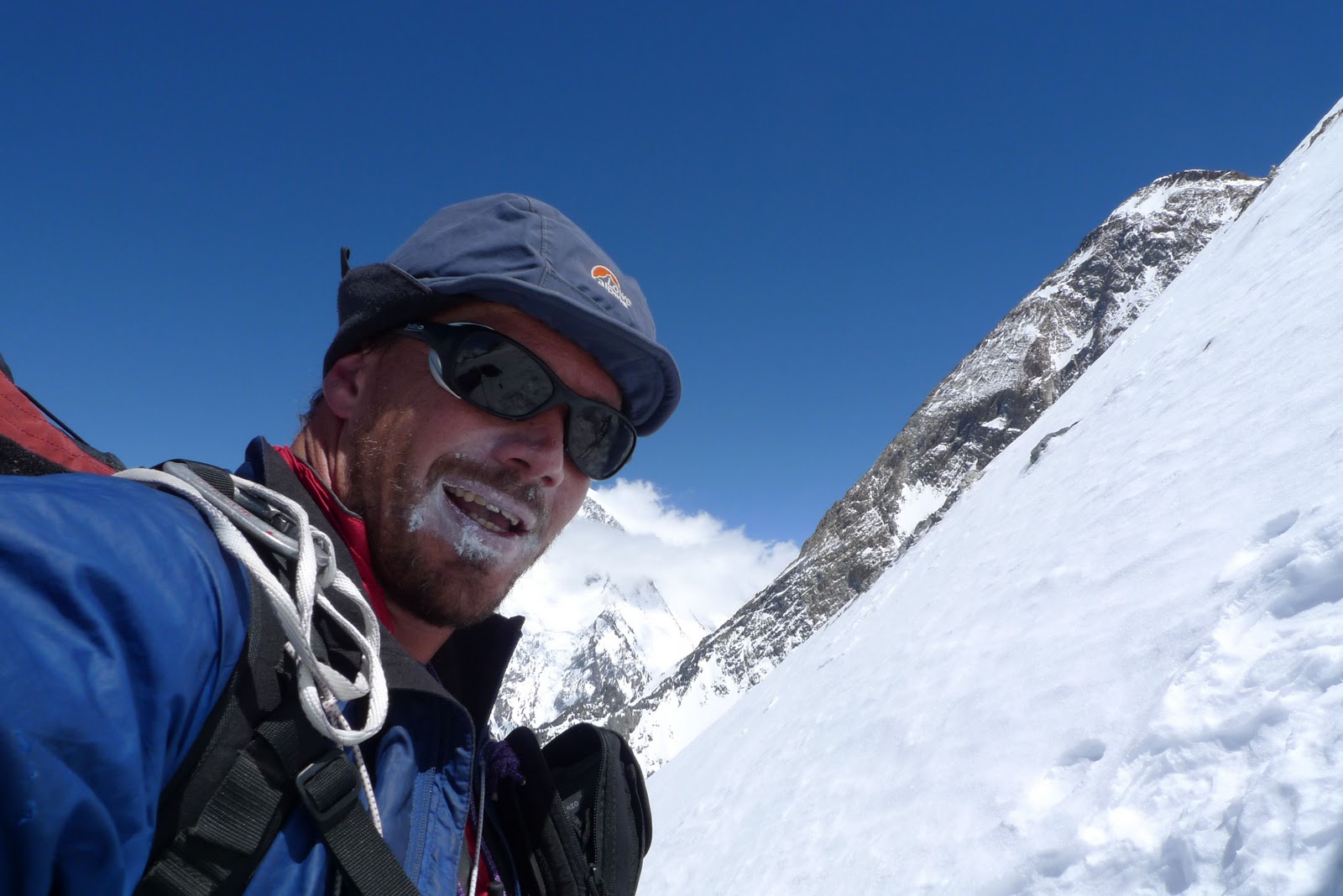
Tom and Ed were friends and business associates in a business that provided logistics to expeditions in China and the Asian region. Tom came as a trekker/photographer and decided we were all so cool to hang out with that he stayed for the entire expedition.

Kat was accompanied by Luis(personal guide) and 2 sherpas Lakpa and Tsering to help out. These guys were a wonderful addition to the team with their huge smiles and great humour. They brought a wealth of experience and fun to the expedition.

Garth's plan was to acclimatise on Broad Peak and try K2. Motivated Megs was on a mission to climb 5 8000m peaks in a year. She had already climbed Lhotse(5th highest in the world) in the spring. Ian had signed on for BC services. Jo was hoping to become the first Norwegian to climb Broad Peak and Mike, the self-confessed mountain tourist outfitted entirely in Adidas attire was enjoying the whole Karakoram experience.

Various other colourful expeditions were also present at BC, South Africans, Swiss, Catalans, Basques, Germans, Russians and Czechs among others. The diversity of people created some interesting and humorous cultural exchanges. Offers of Russian massages, Hunza firewater doing the rounds at parties, Norwegians wearing mankinis in a wading pool and Czechs cruising around BC in bike shorts and down booties made for some rather amusing moments.

The route up the mountain vaguely follows the west ridge of the mountain. The route to camp 1 (5700m) crosses a glacier, then follows a rocky gully and onto a snow slope about 40 degrees. Camp 1 sits on a little ridge with room for about 6-8 tents. From Camp 1 to camp 2 (6100m) the route follows the west ridge through some rocky pinnacles. The higher one climbs, the more stupendous the view becomes. Views of K2 and the surrounding peaks become increasingly incredible.

Camp 2 consisted of a series of ledges chopped into the icy/rocky slope at around 6100m. After spending a few nights at camp 1 and climbing up to camp 2, we climbed directly to camp 2 in a single push from base camp. Once acclimatised, we could climb to C2 in about 6-7 hours.

These pushes up the mountain were made in the intermittent good weather windows between the storms that plague the Karakorum summer season. During the storms that battered the mountain , high winds and snowfall hammered the mountains, destroying tents and depositing deep snow on the upper mountain. Because of the limited tent space, our team was staggered in our pushes up the mountain so we could all get some acclimatisation in. Most of the K2 climbers had only planned to climb as high as C3 on Broad Peak before heading to K2.

With one more marginally better weather window forecast before the Broad Peak expedition ended, those of us that intended to climb without supplementary oxygen, Meagan, Ben, Brian and I headed up in shitty weather to get in position for the summit push. Those using oxygen on the summit push, Chris, Mike and Jo followed a day later along with Fabrizio. Ideally, we would have spent a night at camp 3 then descended to BC before going for the summit push so that we were more acclimatised, especially for those of us not using oxygen. Oxygen reduces the effective altitude and keeps the climber warmer, reducing the chance of frostbite and making the climbing easier. The weather looked like crapping out for at least a week after this window, killing any chances of another summit attempt. This was our chance.

Various other teams were also planning on going for the summit on the same day. The best day of weather was forecast to be the 17th July. The Basques and Mike and Kobi had already attempted the summit twice and been turned around by weather and deep snow. Hopefully with everyone working together, there was a better chance of summiting the mountain.

After a long day climbing from camp 2 to camp 3 (7100m), Ben, Meagan, Taki and Ashgar and I dug some tent platforms and settled in for the night. Unfortunately Brian came down with a case of GI illness and decided to stay in camp 2 to rest for an extra day. Disappointing because I was looking forward to climbing with Brian. We had hung out a fair bit on the trip, climbing together and killing time watching movies and eating some good food.

Ben, Megs and I attacked a big stick of salami for dinner and took turns making water. My toes had become really cold while digging the tent platforms and it took over an hour to warm them up. This had me worried because I knew that above camp 3, there was deep snow and the summit push would require climbing through the night. Despite the warmest boots available, I had suffered cold feet a few times on the trip. I guess there is some cumulative cold damage from years of cold weather climbing. During the night, despite dry socks and down booties, my feet became really cold again so I made the heartbreaking decision to turn around from camp 3. After 5 weeks on the mountain, turning around was never an easy decision but I didn't want to risk frostbite.

When morning arrived, I packed and headed down the mountain, leaving Ben and Megs try to establish camp 4. They struck deep snow and set up the tent a few hundred metres above Camp 3 after climbing for about 4 hours. The deep snow proved too exhausting to continue so they waited for the others to arrive before trying for the summit in the morning.

With Fabrizio, Kobi and the Basques breaking trail on the summit push, the climbers made progress toward the summit until Fabrizio and Chris made the call to descend when the whole slope shifted under them. The descent back to camp 3 required fixing some ropes to descend over crevasses. The whole team made it back safely with Mike and Brian opting to stay at camp 3 for the night and descend in the morning. The following day, all the wearied climbers made it down to BC safely.

Brian, exhausted from the efforts on summit day and a night at needed a some help from Mike to descend safely. Fabrizio in yet another superhuman effort sprinted up to C2 in about 4 hours to help his good mate. It was hard being at BC and wanting to help but all that could be done to help was being done. Fabrizio was the fastest and strongest guy on the hill. I was great to have everyone down safely in BC.


A few days later, our porters arrived to help us walk out of the mountains. It was sad to split the team up as the K2 climbers were staying for another week or 2, but the Broad Peak climbers were all looking forward to walking out and getting home. Mike, Jo, Ben, Ian, myself and Deedar, our cook planned to walk out over the Gondogoro La (pass) to Hushe, a shorter route than the Baltoro. We left on the 20th July and headed south from Concordia towards Chogolisa, passing the Gasherbrum peaks on the way. We were joined by 7 porters.

The next passage was written by Ben Kane. I couldn't have written it better. Ben has captured the experience perfectly.

"After hiking for 8hrs on snow, ice and moraine we came to Ali Camp, nestled in a rocky outcrop overlooking a huge glacial basin. We took a few hours rest and enjoyed Deedar's spicy meal of chili yak and chapatis, complimented by warming chai.

We woke at 2am to the sound of snow on the tent, but to our relief it was rather warm once we got moving. Walking by headlamp at night never ceases to inspire me, a totally different world, with the sound of the snow crunching under our feet, spindrift blowing in your eyes. As the dawn approached we caught sight of the pass ahead of us, a steep passage between even steeper slopes. We were joined by 2 members of the Gondogoro Rescue team - there to ensure the fixed ropes are in place and secure.

Our views were limited upon reaching the top of the pass, low lying cloud but with the morning sun breaking through in places offered us a glimmer of hope for the remaining 8hrs of hiking still ahead of us. The far side of the pass is much steeper and we made good use of the fixed ropes. As we approached the snow line down the valley Rob and I stopped, hearing a mighty avalanche on the other side of the valley. This continued for nearly 2 minutes, and at last came spewing down out of the mist. Knowing we were on safe ground, we stood there and took in an amazing sight. This was by far the largest avalanche I have ever witnessed.

At the bottom the valley we huddled in a small stone hut, where we enjoyed a hot breakfast of eggs, paratha (fried chapatis) and more warming chai. This set us in good stead, as the next 8 hours consisted of hopping, skipping and jumping our way across a maze of glaciers and down a winding valley.

Cresting a ridge, we finally caught a glimpse of Saicho, the beautiful oasis-like camp where we to spend a much anticipated night in the richer, moisture-filled filled air. Coming down into Saicho your senses are bombarded, the sound of the streams cascading and the birds chirping, the smell of juniper and rhododendron flowering and the sight of so much green...plants living and thriving, unlike the bleakness of the Godwin-Austin glacier, where our home has been for the past month.

The next morning we had an early start arrived at Hushe in time for breakfast and ready to jump into the jeeps for our drive to Skardu. During the 5hr drive we were able to reflect on our time on Broad Peak, and prepare to head back into our 'real' lives back home. Each expedition is a holistic experience, taxing mentally, physically and emotionally and we take so much away from these times. " - Ben Kane

The drive back to Skardu was amazing, driving through apricot groves and lush cultivated fields. The air tasted thick and sweet in the lower altitudes. 36 hours later we arrived in Islamabad via another trip along the KKH. An incredible trip which I am still digesting. It was great to spend time with old friends Ben and Chris and meet lots of new ones. The many good times will be remembered.

Big thankyou to Fabrizio, Chris, Ben, Stu (Field Touring owner), Brian, our awesome base camp staff and all the others who contributed to making this an amazing trip.

Thursday, June 10, 2010

Welcome to Pakistan

"Every man's life lies within the present; for the past is spent and done with, and the future is uncertain".
Marcus Aurelius

Sometimes you just have to go somewhere to see a place and experience it for yourself. Believing everything you see in the media or heeding government warnings about instability in certain countries only distorts the reality and creates the wrong perceptions. Sure, there are places in every country that are dangerous and volatile, but these places exist in every country.... LA, New york, London, Sydney. I guess Pakistan is like that too, but I had to see for myself. Trouble wont find you if you don't seek it out.

I guess my lifestyle of working and going on intermittent climbing expeditions leaves people wondering when they'll see me next or what adventure I'm embarking on next. The most common reaction when I mentioned I was going to Pakistan was usually disbelief and I get bombarded with an array of questions.

Is it safe?
Why are you going there.?
and the usual question.. When are you climbing Everest? (I don't bother answering this question because its stupid )

After arriving at 2am, a few day ago, I've been settling in to the new pace of expedition life. Seeing and experiencing a new country and culture with the anticipation of heading to the mountains again is amazing.  I arrived ont he same flight as one of my team mates Brian and we've been cruising around and checking Islamabad out.

First impressions are of an ordered moderate country with incredibly friendly people who try to be helpful despite the language difficulties. The roads are a bit chaotic and probably the most dangerous part of this trip. We have already been in a low speed collision in a car with no seatbelts with a car that had no tail lights. No damage to vehicle or persons. It was actually pretty funny.

I  had sent a barrel of gear over as unaccompanied baggage so Brian and I spent half a day in customs trying to retrieve it. It became rather comical and if Brian hadnt been told that he couldnt use his video camera, we would have had it on film. Its incredible how many people are required to do one job. Everyone was very helpful though.

Now we are just waiting in Islamabad waiting for a flight to Skardu and the mountains. Today the flights have been commandeered by the army and the president so we went dvd shopping.

There arent many tourists here this year. only 25 expeditions have been issued this year and the locals have been suffering the decline in business. Compared to over 80 expeditions last year and over 6000 permits issued in 1997.

stay tuned

Sunday, June 6, 2010

A new adventure in the Karakorum - Broad Peak 8047m


Its been a good year so far and the new adventure is only a few days away as I'm writing this post. 

Sometimes when life seems more hectic than it should, we have 2 choices. Back off and relax or embrace the lifestyle. This year has been more fast paced than most but I've been enjoying it. Maybe it's the adrenaline or the coffee thats keeping me going. Either way, as soon as one challenge or task finishes another seems to take its place. My workmates, friends and family must witness the blur with some disbelief. Combining work, training and a new relationship presents its own unique challenges, but its surprising what one can fit in when you reduce the amount of sleep you really need, add some caffeine and just get on with it. As long as you are enjoying it, keep going.

The Karakorum mountain range in northern Pakistan contains some of the most awe inspiring mountains on earth. I've stared at photos and read books and magazines about mountains and adventures in this almost mystical place, promising myself that I would make it there one day. 

After returning from a successful expedition to Cho Oyu (8200m) in Tibet in 2008, I had planned to try another 8000er and combined with a trip to a new and fascinating country and mountain range, Broad Peak (8047m)  fitted the bill. More technical and steeper than Cho Oyu with a lot fewer people than Everest. With my usual climbing partners unavailable, I'll be climbing with Chris Symiec and Ben Kane. Two great guys who I've met on previous trips. 

The excitement is building as I am finishing the last stages of packing and making sure I have everything. 

Tuesday, February 2, 2010

Adventures in the Patagonia- Cerro San Lorenzo

Where to start writing a perspective on an amazing trip into the wilds of Patagonia......

An Objective

Once, we had decided to go to Patagonia, all that remained to decide was what we we going to do there. Would we go to one of the famous climbing areas such as the Torres del Paine in Chile or the Fitroy area, where I had been 4 times previously and still had unfinished business? or a completely new adventure to a relatively unknown and little explored area? Mick Fowler, the legendary british alpinist had been there a few months earlier and had been thwarted by bad weather and heavy snow but it inspired us enough to commit to a trip there. We had a couple of photos and some aerial photos but that was about it. We all geared up for a great adventure. We had no assurances that we would be able to climb anything. The Patagonian weather is famously unstable and Cerro San Lorenzo is the second highest mountain in Patagonia at 3700m. The plan was was to explore the area and hopefully climb a new route on the beautiful Pilar Sur (south pillar) of San Lorenzo. Conditions, weather and our abilities to climb and suffer would ultimately decide on the success of our mission. With such uncertainties and a dynamic team, the trip would be a great adventure.

"Patagonia is not a precise region. It is a vast vague territory that encompasses 900000 square kilometres of Argentina and Chile. Patagonia can be described by its soil and climate. The wind that blows with terrific force from october to March- in Chatwins expression "stripping men to the raw" and made Antoine de St Exupery's plane fly backward instead of forwards. In Patagonia, the isolation makes it easy to exaggerate the person you are: the drinker drinks, the devout prays, the lonely grows lonelier, sometimes fatally" - from Bruce Chatwins book 'In Patagonia'

The Team

Pete- Super psyched, incredibly fit,  strong and fast climber and runner. Scottish winter climbing enthusiast. Recently completely his PhD.
Timmy- Sheffield based climbing enigma. Immensely talented understated all-round climber and super relaxed guy with a penchant for classic one-liners. I had first met Timmy in 2006 in Patagonia then again in the UK in 2007.
Donie - Irish and living in Sheffield. Determined and talented climber and excited as muh about climbing as having a relaxing holiday. Incessant sweet tooth. Favorite quote "What can we eat next?".

Ronan. - Born and bred in Dublin Ireland. I hadn't met Ronan before this trip. All I knew was that he was super psyched and had an immense dislike for Netto canned food. Ronan would prove to be incredibly fit, strong and stoic in the face of a traumatic injury. If the shit hit the fan, Ronan is the guy you'd want on your side. A real asset to the team.

Rob - Australian component of the team, communications and equipment manager, base camp chef.

Ross - Unfortunately Ross couldn't join us on the trip, but he proved to be an invaluable team member by sending us daily weather forecasts to our satellite phone. These forecasts helped us incredibly to plan our missions and enabled us to make the most of the weather windows.

On our way

Most of the team for the trip arrived in El Calafate, Argentina on the 13th December 2009. Tim, Pete, Donie and me. We immediately set set upon the tasks of shopping for food for a month and finding the best way to get to the mountains. We were headed to a mountain called San Lorenzo, located about 6-7 hours north of El Calafate off the famous Route 40 through the pampas of Patagonia. 5 trolleys of food were filled in the supermarket and somehow we managed to forget 2 of them when we went through the checkout!

A day later, we were on the road to nowhere, heading up the loose rutted gravel road known as Ruta 40, 5 guys, our trusty driver Gustavo, all our equipment and 25 days of food. Gustavo left us at the end of the road with a promise to pick us up again in 25 days. We would see no one else in the entire month in the mountains.

Over the next few days, we carried loads a few hours up to a base camp further up the valley next to an old gaucho  hut- El Puesto San Lorenzo. This quaint little hut would be our home for the next month.  The hut contained a fireplace and a table and a makeshift bed and was mostly watertight. The hut lay in a meadow and was surrounded by mountains, rivers and fields of wild flowers. Not a bad place to spend a few weeks.

The first weather window looked to be a short one so Pete, Timmy and I headed off one afternoon to climb a nearby mountain called Cerro Hermosa (2500m). IT would be a good chance to climb together and test the equipment. After about 3 hours we reached a suitably sheltered spot to spend the night and hunkered down away from the roaring winds, hoping they would abate by morning. It ended up raining all night and all we had for shelter were our bivi bags. I was greeted to an amazing sunrise and still strong winds. Pete and Timmy were still asleep. When they awoke at 8am we decided to have a go at climbing the mountain despite the strong winds. It didnt look too technical but would be about 1000m of altitude gain to reach the summit.

We soloed a wide snow gully to a col, then up another steep couloir to an exposed ridge to gain the windy summit ridge and made it to the rocky summit by about midday. After a fast descent via di=own climbing and bum sliding we reached the bivi around 4pm and were back at base canp by 7pm.

Meanwhile Donie and Ronan (D&R) had explored up the valley and glacier toward the South Pillar of San Lorenzo. It took them 2 days to find their way over the glacier and horrific moraine and setup their advanced camp in the cirque of towers dominated by the Pilar Sur. They arrived back on the evening of the third day thoroughly tired but excited by the prospect of a new route on the pilar sur.

Bad weather and heavy snowfall dominated the next two weeks of the trip but the weather was always better away from the mountain so we were able to go bouldering almost every day on the boulders near base camp. The boulders were amazing, offering beautiful problems of all difficulties on beautiful solid rock with mostly excellent soft landings.

A few days after christmas, the weather report looked good, so all five of us headed up the valley toward San Lorenzo, with the hope of being able to climb. We were rewarded for our efforts by soft knee deep snow covering the ice and loose boulders of the moraine. The going was tough with heavy packs  with the unstable footing underneath.

About 3 hours into the approach, while having a break for a drink and snack, Pete spotted a wild puma up on the  glacier about 40 metres away. It was an incredible privilege to see such a majestic creature in the wild. He continued on his way, not seeming too worried about us and eventually joining our tracks and following them off the glacier. This was definitely one of the highlights of the trip for all of us.

Upon reaching a previously placed gear stash further up the glacier, we all decided that the amount of snow on the mountain and glacier would make any climbing and approaches difficult and dangerous. D&R returned to base camp and Pete, Timmy and I pitched the tent and stayed the night in the shelter of a huge boulder in the hope of getting some good views of the mountain in the morning. The morning greeted us with stunning views of the mountain and the lower half of the Pilar Sur. Hopefully we would get  a weather window to attempt the Pilar Sur.

While we waited for the deep snow to clear of the mountain, Tim Pete and I made the most of a nice weather day and climbed a new route on an astounding basalt tower perched on a hill to the east of base camp. With an approach that was becoming familiar on this expedition, we left the puesto at 10:30am and arrived at the base of the tower after about 3 hours of constant uphill hiking on scree and snow, finding some guanaco footprints high on the hillside. No idea what a guanaco was doing up so high on a mountain devoid of vegetation. Upon inspection of the rock and finding it prone to breaking off in chunks, we decided to climb a new line on the unclimbed west face which offered some protection for the belayers in the form of little overhanging pods. Leading was precarious and time consuming. Every hold needed to be tested to check it was solid before trusting it. 3 long pitches got us to the top of the tower and 2 rappels later down the snow filled south gully and we were back at our packs. We decided to descend a different valley and ended up in a steep canyon, unsure whether it would cliff out or provide a way out. eventually we made it back to the base camp hut around dark.

A few days later with the huge mushroom cloud still enveloping the mountain, we headed up to climb a new route Pete had spotted on a big granite buttress high above the glacier.  Pete, Tim and I led a pitch each on perfect featured granite to the top of the buttress with 3 condors circling overhead, sometimes no more than 20 metres away. These majestic birds with massive wingspans just seem to soar in the winds of the Andes with seemingly little effort. Tim was the smallest of the 3 of us so we figured he would be the one carried away if they were to attack. Pete and I were quite content to watch the action. A short scramble down a scree gully led us back to our bags.

The weather and conditions on the mountain had dictated much of our activity and decisions. A huge mushroom cloud covered the mountain for most of the time and the wind seemed to blow incessantly. With some previous Patagonian experience, I had expected this to be the case but San Lorenzo seemed even more intense than other Patagonian peaks I had tried.

The weather for the last week of the trip didn't look promising with high winds and precipitation but it would be our last chance for an attempt on the pilar sur, so after a morning of rain we packed and headed up the glacier with the aim of reaching the advance camp before nightfall. The snow had all melted off the glacier which made the going easier than the previous trip. About half way up the glacier on the blue ice, Pete managed to step into a deep glacial pool of freezing water while gazing at the huge east face of San Lorenzo. I was just behind him at the time and wondered why he hadn't seen the pool . He lunged forward and managed to scramble out thoroughly wet and rather pissed off.  After the blue ice, we had to negotiate some horrible moraine for a few hours to reach the advance camp. About 8 hours, we reached the advance camp and began digging a hole and building a snow wall for the tent to protect against the ferocious winds.

The approaches in Patagonia always seem to test one's resolve, whether it be cold river crossings, marshy wetlands, rubble covered glaciers, deep snow or horrible loose moraine with loose boulders toppling under one's weight. Combined with a heavy pack, these approaches always seemed to weary the body, knees and feet. Its all part of the experience and most of us had some sort of niggling injury of another. We usually just taped up the offending sore appendage and popped some ibuprofen and kept going. We were all in the same boat.

The rain started about 11pm and continued for the next 30 hours unabated. I was sharing the tent with Tim and Pete, while Donie and Ronan were in the other tent. The bad weather provided a rest day that was almost welcome after the previous exhaustive day. We became quite good at killing time on this trip by reading, and playing chess and sleeping.

The next day dawned clear and bright. It was on. We packed and headed up for an attempt of the couloir  on the pilar sur. We didn't really know exactly where we were going but we tried to find the line of least resistance to surmount a ridge and access the big ice couloir on the pillar. The fresh snow was getting softer and wetter and in danger of avalanching as the sun hit it. Our crampons bit into the hard neve underneath in a hurry to get onto the steeper less avalanche-prone rock buttress above. A few hours after we had climbed the initial snow slopes, they completely avalanched  and left the hard snow and rock beneath completely scoured and devoid of snow.

After 4 pitches of mixed climbing up snow and rock, we reached the crest and committed to an abseil down the other side of the ridge and into Chile. The climbing was time consuming and the afternoon was getting on, but the couloir beckoned so up we headed. The rock on the upper section of the pillar was completely coated in rimed ice and a few centimetres of verglas. It looked unclimbable  and incredibly hard but we headed up anyway, Simul-climbing and pitching our way up the couloir using ice screws in the blue ice to protect our passage.

The higher we climbed and the later it became, the colder it became. Wind and blown snow  seared our faces and nipped at our fingers. Upward we climbed until we had a good view of the upper pillar. It was obvious that we weren' t going to the top that day and spending the night out without a stove and sleeping bags wasn't an option. I was wearing every piece of clothing I had with me and I was still on the point of shivering. We decided to descend with still a few hours of daylight remaining at  around 8pm. Timmy led the way, drilling v-threads in the ice as rap anchors. I went 2nd to test the anchors and Pete came last after removing the backup ice screw.

As we descended, we passed Donie and Ronan who climbed on past us. Ronan was powering on like a machine, the fire in his eyes and looking strong. An image that will stay etched in my memory. A few hours later we saw their headlamps slowly descending the couloir behind us.

We reached the bottom of the couloir just before dark to find our water bottles had frozen solid allowing us only a trickle of fluid. We continued the descent in the dark, trying to find a way back over the ridge back to the advance camp in the cirque. After 5 abseils down a steep gully and a descent across the avalanche scoured slopes, we made it back to the tent at about 4am in the morning. We had been on the go for about 20 hours and slept the sleep of the dead.

Donie and Ronan arrived back at their tent about 10am after a long descent. Ronan had seriously frozen his fingers rigging the abseils down the couloir so they had to go the long way around to get back to the tent. He said fingers were bad, but the reality of how bad probably hadn't sunk in because of the tiredness of the last 24 hours efforts.

By morning, the mountain was shrouded in cloud and strong winds were battering the mountain. I packed up and began the long walk out back to base camp around midday, arriving around 9pm. The camp site was relatively sheltered but as soon as I hit the glacier, the wind battered me and threw me around, threatening to push me into the clear blue glacial pools that covered the glacier. Pete and Tim followed shortly after and decided to climb a nearby peak the next day called Cerro Penitentes.

Donie and Ronan arrived back around midnight the following day after a 12- walkout from advance camp. Ronan showed me his frosbitten fingers and I was shocked at how bad they were. There wasnt mch we could do except keep them clean and dressed and to prevent the blisters bursting and the risk of infection. It would be 4 more days till we got to a hospital for any advice and treatment.

A few days later, after carrying a few loads of gear out and eating the lst of our food, we met Gustavo at the pick up point and began the 7 hour drive back to civilisation. Ruta 40 was littered with a few 4x4 trucks on their roofs and one with a broken axle, testimony to the savage nature of the roads in this area of Patagonia. At one point, I was jolted awake (as usual I was sleeping in the car) by the van fishtailing on the loose gravel. We all braced for a potential roll over but thankfully Gustavo was experienced on these roads and kept the power on to pull us out of the fishtail. Could have been nasty.

I accompanied Ronan to the hospital where we had his finger redressed and checked by a doctor. Only time would tell how well they healed up. Not many doctors in the world have experience treating frostbite so good advice is sometimes scarce.


Over the next few days, Donie and Ronan caught their flights home and Pete Tim and I did some fantastic climbing and bouldering around El Calafate......And ate lots of BBQd meat, courtesy of my amazing Argentine friends Paula and Manza.

With an extra week to kill and the weather not looking favorable, I decided to head down to Chile to the Torres del Paine for a few days of trekking and taking photos. Somehow I managed to forget my sleeping bag and spent 4 cold nights sleeping with all my clothes on and my feet in my pack. All good training for future missions. In 5 days, the weather dished out glorious sunshine, 70km/h winds and driving rain, delivering astounding beautiful views of the surrounding mountains and rivers in the national park.
The last few days of the trip were spent idly packing, climbing with the locals and fantastic asados (BBQ) every night. A visit to the Perito Moreno glacier where Paul and Manza worked provided a welcome outing and some great photo opportunities. With the business end of the trip done, these downtimes can be some more relaxing parts of a trip and an ideal time to wind down and reflect on a great trip. The mountains and the landscape were simply incredible.  The 5 of us made for a dynamic team of good friends, great humour and great climbing partnerships and some truly memorable adventures... Thats what its all about. ..


Wednesday, December 9, 2009

Back to Patagonia

After a few months at home, the feet get itchy and a new adventure beckons. I've been sorting and packing gear for a few weeks now, not wanting to forget anything.

Back in July, I received an email from some english mates Timmy and Pete. They were super keen for a big adventure so I suggested a trip back to Patagonia in southern Argentina.

I had been to Patagonia 4 times before and Timmy had been twice. This would be Pete's first trip there. After a bit of research, we decided to go to a new area, more remote and wild than the areas we had been to before. I was psyched. A big adventure with good friends. The mountain we decided on is called San Lorenzo (3700m).

Not many people go there. Patagonia is known for its wild weather and storms. We'll see what happens. .....


Tuesday, December 8, 2009

More than we bargained for – (Cho Oyu (8200m), Tibet. September /October 2008)

“Life is either a daring adventure or nothing. Avoiding danger is no safer in the long run than outright exposure. The fearful are caught as often as the bold.” - Helen Keller

Life seems to have its many twists and turns and in many ways we create these ourselves. Blaming others for our misfortunes or things that don’t turn out as planned seems a pointless exercise. We all have a hand in the creation of our little worlds and it is up to us to extend ourselves beyond these microcosms beyond our own limits and concepts of what is possible.
Climbing mountains is something I choose to do for the challenges and experiences encountered.

For some reason, I had delayed writing this story until now, nearly 12 months after our return from a mountain that took its toll on my mental and physical state. The experience affected me in so many ways that it was difficult to adjust when I returned to everyday life back in Australia. This has often been the case after I have returned from an arduous expedition. Reality doesn’t really seem real anymore and my friends and family back in Adelaide could never really understand the transition required from the mountains back to working life in Adelaide. I just try to get back into the swing of everyday life again, which isn’t always easy after the single-minded intensity of mountain life. I’ve mostly recovered from the effects of the trip to Cho Oyu but the experience will stay with me for many years as I’m sure it will haunt some of my fellow team mates who shared the good times and the tragedies that we endured on the mountain.

There are many missing details to this story, but I have tried to capture the essence of my experience. Everyone’s experience is different and valuable. Each person’s experiences opens their own doors of perception. Memories fade with time and the haze of altitude. This is just my story as I remember it…….

Ever since I began climbing, I had read books about the climbing in the Himalaya and dreamed of climbing there myself one day. There are fourteen mountains over the magical height of 8000m in the world, all of them situated in the Himalayan chain stretching from the Karakorum in Pakistan to Tibet and Nepal.

Nima, my trusty, incredible agent and friend in Nepal let me know that he was organising an expedition to Mt Cho Oyu in Tibet for a company called Field Touring. The trip was being led by a guy called Stu, who I had met previously on an expedition to Ama Dablam in 2005. Ryan Castel, my keen climbing partner on a few previous Himalayan trips didn’t need much convincing to sign up for the trip. We would be sharing base camp and logistics with the Field Touring team. Above base camp, we would be on our own. We planned to climb a different route on the mountain than the rest of the team to make things a bit more interesting, just in case 8200m wasn’t interesting enough.

Due to escalating troubles in Tibet, the Chinese authorities were reluctant to issue permits and although we remained hopeful, it was looking grim. Thankfully one week before departing Australia, we received our permits to climb the mountain.

We all arrived in Kathmandu in early September and prepared to travel overland to Cho Oyu via the Chinese-built friendship highway. Our international team bus weaved its way from the warm Nepalese forests to the arid Tibetan plateau. 6 days of gradual ascent through the ghost towns of Nyalam and Tingri gave us an opportunity to get to know each other and sample the local cuisine and toilets.

A week after leaving Kathmandu, we arrived at advance base camp (ABC). ABC was perched at 5700m on the moraine wall of a massive glacier overlooking the Northeast face of the mountain. A kilometre from the camp across the Nangpa La pass lay the lush green valleys of Nepal, a world away from the dusty cold Tibetan Plains.

After a few days of adjusting to the altitude at ABC, Ryan and I set of on a reconnaissance mission to have a look at our intended route on the mountain, the South West face. We watched it for a few hours through the obscuring clouds and hoped the conditions on the face would be conducive to a safe and fast ascent once we were acclimatised. The face looked steep intimidating and foreboding. A great adventure in the making.

We planned to acclimatise to the high altitude on the mountain’s normal route. 5 hours from ABC across the moraine of the glacier and up a few hundred metre scree hill lay camp 1 at 6400m. We pitched our small tent in a small hollow below the snow ridge, hoping to find some protection from the typical strong winds found at that altitude. After an initial load carry to camp 1 we headed up again to spend 3 nights at camp 1 and hopefully one night at camp 2.

On arrival at camp one, we witnessed the devastation on other expedition’s tents from the previous day’s storms. Tent poles were snapped, tents were ripped to shreds and some tents and all their contents had simply blown off the mountain. For some people on the mountain, this spelt the end of their expedition. The first night at a new altitude always hurts. Headaches and lethargy were the order of the day. Time at camp was spent reading, listening to music, cooking and reinforcing the guy lines on the tent. Killing time is an amazing skill to have on expeditions. As the body gradually adjusts to the altitude, the strength returns and the urge to venture upward is renewed.

After 3 nights at camp one, Ryan and I gathered the minimum of equipment and headed up the mountain with the intention of staying a night at camp 2 (7100m). The weather showed signs of changing for the worse. Hopefully it wouldn’t be too bad! The route to camp 2 followed a steep ridge followed by 2 steep ice cliffs. The hard blue ice through the ice cliffs made the lungs burn and calves ache with every effort. Camp 2 was a desolate wind swept little plateau littered with tents from the many other expeditions on the mountain. Our tiny single skin tent was a battle to pitch in the wind storm that had been brewing. With freezing hands and faces we crawled into the tent and tried to warm up despite the wind blown spindrift that filled the tent. With thumping headaches and 50 - 60 knot winds hammering the tent all night, there was not much sleep to be had. When morning arrived, we collapsed the tent and gratefully headed down the mountain and back to base camp; our acclimatisation complete. Ryan declared it his worst night ever in the mountains.

Now all we needed was a 4 day weather window for a summit attempt. With the large amount of snow and bad weather that had pummelled the mountain, we decided against the SW face in favour of the NW face route.

After about 4 days rest and preparation in advanced base camp, we headed up the mountain hopefully for the last time, but uncertain what the next few days would bring. Climbing at high altitude requires constant attention to one’s own health and the conditions on the mountain. Ryan and I had never been this high and were stepping into unknown territory. This was why we came to climb this mountain.

Camp 3 was perched on a steep incline above some rocky cliffs at 7500m. No one stays here long. The human body is continually dying at this altitude and time up here is borrowed time. We only had a few hours at this camp to brew up and prepare for the summit attempt. All movements were laboured at this altitude, even lacing up our boots took minutes. We slept fitfully for a few hours in all our clothes, sharing a single sleeping bag to save weight.

At 2 am, Ryan and I left camp 3 for our summit bid. I carried a camera, 2 litres of water, some energy gels and an ice axe. Ryan and I chose not to use supplementary oxygen on the climb so we wore only the clothes on our backs. Other climbers and Sherpa’s from other expeditions that were using oxygen romped past us on the initial slope above camp 3. We were forced to wait for about an hour at the base of the crux rock band. The cold crept into my feet and fingers, threat of frostbite very real. I planned to go home with all my fingers and toes, even if it meant not going to the summit. As long as I could feel and move my fingers and toes, they would be OK. Finally through the rock band I kept moving and stayed warm, moving by the light of my head lamp and desperately waiting for the sun to rise add some warmth to the -30 degree dawn hours.

5 steps, 10 breaths 5 steps 10 breaths was the rhythm I followed for most of the day. I was wrapped up in my own little world of determination and perseverance. The bitter dawn wind was freezing my eyes, the damage only noticeable a few hours later when the vision from one eye turned blurry.

Movement created warmth and the summit loomed closer as the sun rose in the sky. As Ryan and I leapfrogged upward, we passed other climbers descending. Most of these climbers were in guided groups and using supplementary oxygen to climb the mountain. By using oxygen, these climbers were able to climb faster and stay warmer, a luxury we didn’t afford ourselves. Ryan and I wanted to experience 8000m in all its rawness to gauge how our bodies would react at that altitude. Cho Oyu was intended as a stepping stone for bigger peaks in the future.

Upon reaching the summit plateau, the summit was still a long way off. We would know when we reached the summit because we would be able to see the other Himalayan giants, Everest, Lhotse and Makalu. After an hour, the unobscured view of Everest and Lhotse came into view. It was midday on the 2nd October. I was on the summit. Emotion welled up inside me. It had been a long, hard road to get to here and it all seemed worth it. I looked behind me to see where Ryan was and there was no sign of him. Looking back on summit day, there were whole parts of the day that are missing from my memory. Last time I checked, he was right behind me. Eventually he arrived and we exchanged a wearied summit hug. We had climbed together on all our Himalayan trips and the friendship had grown into a loyal and solid partnership. It was great to share the success with a great friend.

After the obligatory photos and Snickers, we headed down, well aware that we were far from safety and the descent would require the utmost care. The 2 litres of water in my jacket had frozen solid so I was getting a bit thirsty. On the descent around 230pm we came across a jovial Canadian from our team called Guy L. He was moving too slowly to make the summit that day and descend safely, so we let him know that the summit was at least 4 hours away at the pace he was moving. He continued upward confident and enjoying this amazing day in the mountains. Something didn’t seem quite right, but no one seems to think to clearly at that altitude so we continued downward toward the tents and safety. Little did we know that was the last time we would see Guy L and experience his big smile.

After a few abseils through the rock bands, I reached the final slope leading to camp 3. For the last few hours I had been bursting for a piss but felt the urge to keep moving downward. Finally a few hundred metres from camp and on a low angle slope, I couldn’t wait any longer. 3 layers of clothing made the task extremely difficult. I didn’t succeed but the layers of fleece and polyester wicked away the fluid. I was beyond caring at this point.

After reaching the tent I ate and melted snow for water. The 2 litres I had carried with me had frozen solid inside my jacket in the cold dawn hours leaving me dehydrated and thirsty. I made the decision to wait for Ryan and then continue down to camp 2 as soon as possible. Staying up high only succeeds in destroying the body further. Ryan was exhausted and wanted to stay at camp 3 that night so I headed down to camp 2 and moved into a tent with Guy and Kit, feasting on Beef jerky and feeling contented after a long and demanding day.

Meanwhile, at camp 3, Justin poked his head into our tent, his face covered in feathers.

“I’ve just had a shit of a day”.

Ryan awoke from his slumber in astonishment. Justin had managed to drop his figure 8 descending device somewhere on the descent and made a mistake on the final abseil. What ensued was a 400metre slide past camp 3 into a massive snow bowl. Lucky to be alive with feathers leaving from his torn down suit, Justin made his way back to camp 3 and crawled into Ryan’s tent.

Stu radioed in at 8pm to let everyone know that Guy L was with him and they were due in camp 3 about 9pm. It was great to hear they were both safe so the radios were switched off.

We were awoken at 8am the next morning by Stu unzipping the tent. He was almost unrecognisable. His face wearied by cold and fatigue, icicles a few inches long clung to his beard and his eyes carried that distant stare.
“Guy is dead, he slipped on the descent”

We dragged Stu into the tent and he collapsed. He had been out all night, coaxing and doing everything he could to get Guy L down safely. He had slipped a few metres from safety. There was nothing anyone could do.

We were all in shock, but needed to regroup and descend the mountain. I escorted Ben and Kit down to camp 1 and filled my pack with everything I could carry. The autopilot kicked in and I continued toward base camp. It soon got dark and I tried to remember the way in the maze of moraine and ice. Somewhere along the way, I encountered another down suit clad climber sitting on a rock. He fell in behind me happy to have someone to follow back to base camp. It turned out he was originally from Adelaide but now living in Seattle. Small world!
Eventually, we made it back to base camp and safety. Exhaustion overwhelmed me as I entered the cook tent and was welcomed by Ratna with a big plate of fried rice and soup. I slept the sleep of the dead that night fully clothed.

Ryan and some of our team were still on the mountain so I took charge at base camp trying to coordinate who was where and trying to work out what was happening. Ryan was making his way down with Justin, who had sustained some serious frostbite to his toes. I had known Ryan long enough to know that he was well up to the task of getting Justin down safely and told him so over the radio. Sometimes you just need to hear that someone has confidence in you. With his hands full trying to get Justin down the mountain, Ryan came across a Slovenian guide called Miha Valic. Miha was in a bad state, slowly dying of pulmonary oedema, but trying to descend under his own steam. Ryan called me to ask for advice on how to treat Miha. Drugs, water and immediate descent were administered. Now Ryan had 2 casualties on his hands.
Something happened to Miha on the abseil down the 1st ice cliff that left Miha tumbling down the slope still attached to the rope. Ryan down-climbed the ice cliff and started CPR in a bid to revive Miha. The reality of giving CPR at 7000m is extremely harsh. It is hard enough to breathe by oneself, let alone try to save someone else. Unfortunately, all efforts were unsuccessful so I searched base camp for Miha’s team mates to break the news. It was a heart-wrenching job to have to do. It was almost unbelievable that a seemingly super-fit and strong guide who had summitted the previous day had now perished.

Ryan and Justin eventually made it back to base camp the next day, exhausted and physically wasted. The whole experience had been traumatic for Ryan. We spent a lot of time talking about the events over the next few days. The experiences will no doubt stay with Ryan for a lifetime. The entire experience brought the whole team together. It was privilege to be a part of such a close knit bunch of guys. No one went to the mountain thinking that it was an endeavour without risk. Losing someone is never part of the plan and I hope it never happens again but inevitably accidents do happen in the mountains.

People have asked me
“Will you go back to the mountains after what happened?

I will always go back to the mountains as long as I am able to. Inevitably events beyond my control will happen. The risks are great, but then so are the rewards. Everyone knows the risks and accepts them to a certain degree. We feel more alive for these experiences and the choices we make.

We chose to travel to the mountain and climb and endure what the mountain handed us. I am stronger for the experience and achieved what I set out to do on the mountain. Why we climb the big mountains is not always clear but sometimes it is better to not ask the question. Sometimes the mountains seem to call me or maybe it’s just where I feel most at peace.

Thanks to all the team Ryan, Stu, Ben, Italo, Guy L, Guy H, Lyngve, Tsering, Ratna, Justin, Kit, John, Eric, Moma and Antonin who made the trip a success with lasting friendships.